Canada Permanent Residency.
End-to-end support for Canadian PR through Express Entry and Provincial Nominee Programs.
₹80,000service fee
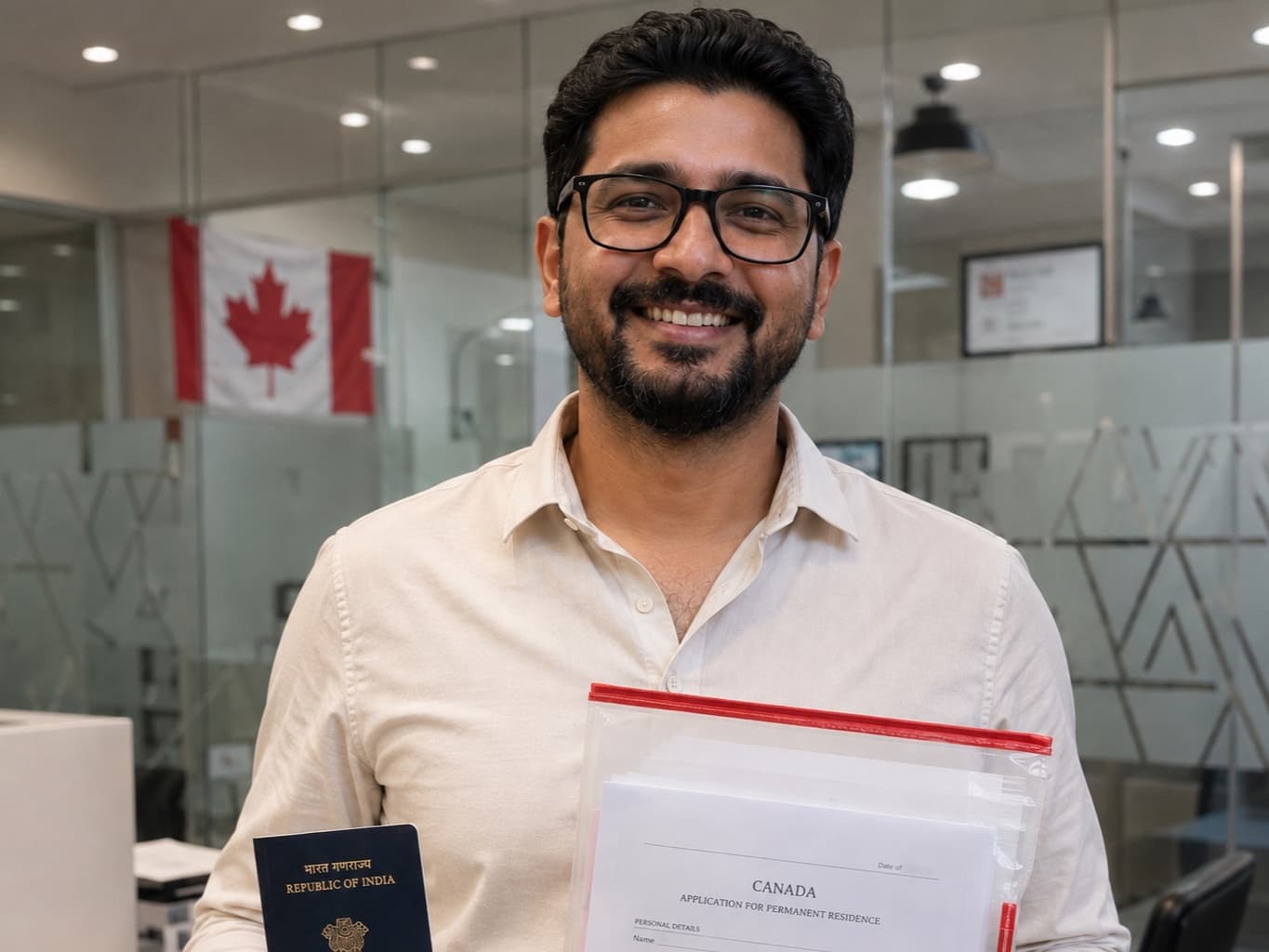
About this service
Dreaming of a new life in Canada? Our permanent-residency consultants turn aspirations into reality with services tailored to your profile — Express Entry, Provincial Nominee Programs and Quebec Immigration.
Our team conducts a thorough evaluation of your profile and gives you a detailed report outlining the best pathways for your qualifications and circumstances.
From initial assessment to application submission and final approval, we guide you through every step and navigate the complexities of Canadian immigration law for you.
What's included
- Profile Evaluation
- Education Credential Assessment / Skill Assessment
- Occupation Code Analysis and Documentation
- IELTS Mentorship for CLB 9
- Proof of Funds and Financing Documentation
- Expression of Interest Filing / Registration
- Invitation-to-Apply Document Process
- Medical and Police Clearance Certificate Filing
- Pre-Landing Job Assistance and Interview Preparation
- Accommodation Assistance
🇨🇦 Country guide
Canada: the long game that still pays off
Points-based, family-friendly and built around permanent residency. Slower than it was in 2022, but the clearest work-to-PR road we file.
- Average salary
- $75,000 CAD
- Processing time
- 6–12 months
- Our success rate
- 94%
- Professionals placed
- 1,200+
Stop 01 · Overview
Canada at a glance.
Canada is the country most of our clients ask about first, and for good reason: its immigration system is designed to turn temporary workers and students into permanent residents. The rules tightened through 2024 and 2025 — lower intake targets, capped study permits, more selective draws — so the easy years are over. What is left is still the most predictable route to PR of any country we serve.
The winners now are people with in-demand occupations, strong English or French, and a realistic plan for the province they land in. That is exactly what a profile assessment tells you before you spend a rupee.
Stop 02 · Strategic pathways
Strategic pathways to relocate.
Six doors in. The right one depends on your degree, experience, money and how much patience you have.
Route 01
Express Entry
For: Skilled professionals with 1+ years' experience
Points-ranked pool. Category draws favour healthcare, trades, STEM and French speakers.
Route 02
Provincial Nominee Program (PNP)
For: Anyone a province wants — often mid-scoring profiles
A nomination adds 600 points and effectively guarantees an invitation.
Route 03
Study permit → PGWP
For: Students at eligible public colleges and universities
Post-graduation work permit of up to 3 years, which feeds Canadian Experience Class.
Route 04
Employer-backed work permit
For: Candidates with a Canadian job offer
LMIA-based or Global Talent Stream for tech roles — fastest way to arrive, PR follows.
Route 05
Family sponsorship
For: Spouses, partners and dependent children of residents
Spouses can usually work while the application is processed inside Canada.
Route 06
Start-up Visa
For: Founders with backing from a designated organisation
PR for the founding team; niche, but real for the right business.
Stop 03 · Visa & immigration
Visa & immigration details.
Every Canadian route scores the same things differently: age, education, language, work experience and adaptability. Get those five right and the paperwork is a checklist, not a lottery.
What you'll need to show
- Educational Credential Assessment (ECA) for every degree
- IELTS General or CELPIP — French (TEF/TCF) adds serious points
- Reference letters proving duties, hours and pay for each job
- Proof of settlement funds unless you hold a valid job offer
- Police clearance from every country you've lived in 6+ months
- Upfront medical exam with a panel physician
- Biometrics at a VFS centre after the application is filed
Stop 04 · Study & education
Study & education.
Canada caps new study permits by province, and colleges that leaned on international fees have lost seats. The upside: the programs that remain are tied to real labour demand, and a public-college diploma still unlocks a work permit and a PR pathway.
- A Provincial Attestation Letter (PAL) is now required with most study permits
- Post-Graduation Work Permit only for eligible public institutions and fields
- Co-op programs mean paid Canadian experience before you graduate
- Two-year diplomas at public colleges remain the cheapest PR-eligible route
- September is the main intake; January and May exist for many programs
Stop 05 · Job market
Job market & opportunities.
Canada hires for shortage, not prestige. Healthcare, skilled trades and logistics are chronically short of people; tech pays well but is competitive in Toronto and Vancouver. Our placements skew towards nurses, PSWs, truck drivers, welders, supply-chain and software roles.
Stop 06 · Can I afford it?
Can I afford it?.
Housing is the honest problem. Rent in Toronto and Vancouver takes a large slice of a starting salary, which is why we push most families towards the Prairies and Atlantic provinces — same PR, half the rent.
Expensive
Toronto · Vancouver
Highest rents in the country; single-income families struggle in year one.
Balanced
Calgary · Ottawa · Montréal · Edmonton
Big-city jobs with rents that leave room to save.
Easier
Winnipeg · Halifax · Saskatoon · Regina
Lower cost, strong PNP streams, employers that sponsor.
Budget for these before you fly
- First & last month's rent as deposit
- Winter clothing and a used car outside big cities
- 3 months of expenses before the first paycheque
- Provincial health card waiting period (private cover)
- Credential licensing fees for regulated jobs
Stop 07 · Why go
Why Canada?.
PR is the default, not the exception
The system is built to keep you. Most temporary routes are designed to convert.
Family comes with you
Spouses get open work permits; children attend public school free.
Universal healthcare
Provincial coverage once you're resident — no premiums for basic care.
Largest Indian diaspora per capita
Brampton, Surrey and Mississauga feel like home from day one.
Citizenship in three years
One of the fastest PR-to-passport timelines in the world.
Safe, stable, boring in the best way
Low crime, strong institutions and a polite national temperament.
Stop 08 · Life there
What's it like to live there?.
Winters are the culture shock, not the people. Expect −20 °C in Toronto and colder in the Prairies, balanced by long bright summers, an outdoorsy weekend culture and cities where Punjabi, Gujarati and Tamil are heard on every transit line.
Stop 09 · Long-term
Long-term: residence & citizenship.
Canada's endgame is clear: land as a worker or graduate, become a permanent resident, then apply for citizenship after three years of physical presence within the last five. Dual citizenship is allowed, though India requires you to surrender your Indian passport and apply for OCI.
- Stage 1
Temporary status
Work permit or study permit — build Canadian experience
- Stage 2
Permanent residence
Express Entry or PNP; renewable PR card, full work rights
- Stage 3
Citizenship
3 of the last 5 years in Canada, language and knowledge test
Stop 10 · Relocation process
Relocation process, step by step.
Eight stops from first call to first paycheque. We run them in parallel wherever the rules allow.
- 01
Profile assessment
We score you on the CRS grid and tell you honestly where you land.
- 02
Pathway selection
Express Entry, a PNP stream, study or an employer route — one plan, not five.
- 03
Language & credentials
IELTS/CELPIP coaching and ECA filing run in parallel to save months.
- 04
Document build
Reference letters, funds, police clearances — audited before anything is uploaded.
- 05
Profile & application
Express Entry profile, PNP nomination or work-permit application filed.
- 06
Biometrics & medical
VFS appointment and panel-physician exam once IRCC requests them.
- 07
Decision
Confirmation of PR or permit approval; we handle any additional-document requests.
- 08
Landing
Flight, SIN, bank account, health card and a first-month plan.
Stop 11 · Taxes
Taxes in Canada.
Canada taxes residents on worldwide income at federal and provincial rates that rise with income. Take-home pay is lower than the headline, but healthcare and schooling are already paid for.
- You need a Social Insurance Number (SIN) before your first payslip
- Tax year is the calendar year; returns are due 30 April
- Employers deduct CPP (pension) and EI (unemployment insurance) at source
- Provincial rates differ — Alberta is lighter than Québec or Ontario
- TFSA and RRSP accounts shelter savings and reduce taxable income
- India–Canada tax treaty prevents double taxation on Indian income
General orientation, not tax advice — rates and thresholds change every year. We confirm the current figures when we plan your move.
Stop 12 · Departure
Ready to start your Canadian journey?
Send us your profile and we'll tell you your CRS score, which province is realistic and whether Canada is worth the wait for you — free, within 24 hours.
Your file could be the next one stamped.
Get a free, honest read on your profile — which country fits, which program to file, and what it will really take.
Free profile review · Response within 24 hours · Mon–Sat, 10 AM – 7 PM